
The honest 30-second answer: if you want to cruise, commute, or just get somewhere enjoyably — get a longboard. If you want to learn tricks, ollie, and skate street or parks — get a skateboard. If you’re not sure which of those describes you, keep reading.
Most comparisons on this topic spend a lot of time on dimensions and flex ratings. That’s not the useful part. The useful part is matching the board to what you’re actually going to do with it. For a deeper look at how longboards work across different riding styles, the longboard vs. skateboard guide on our hub page covers the full category overview — this article focuses on helping you make the call for your specific situation.
The Differences That Actually Matter
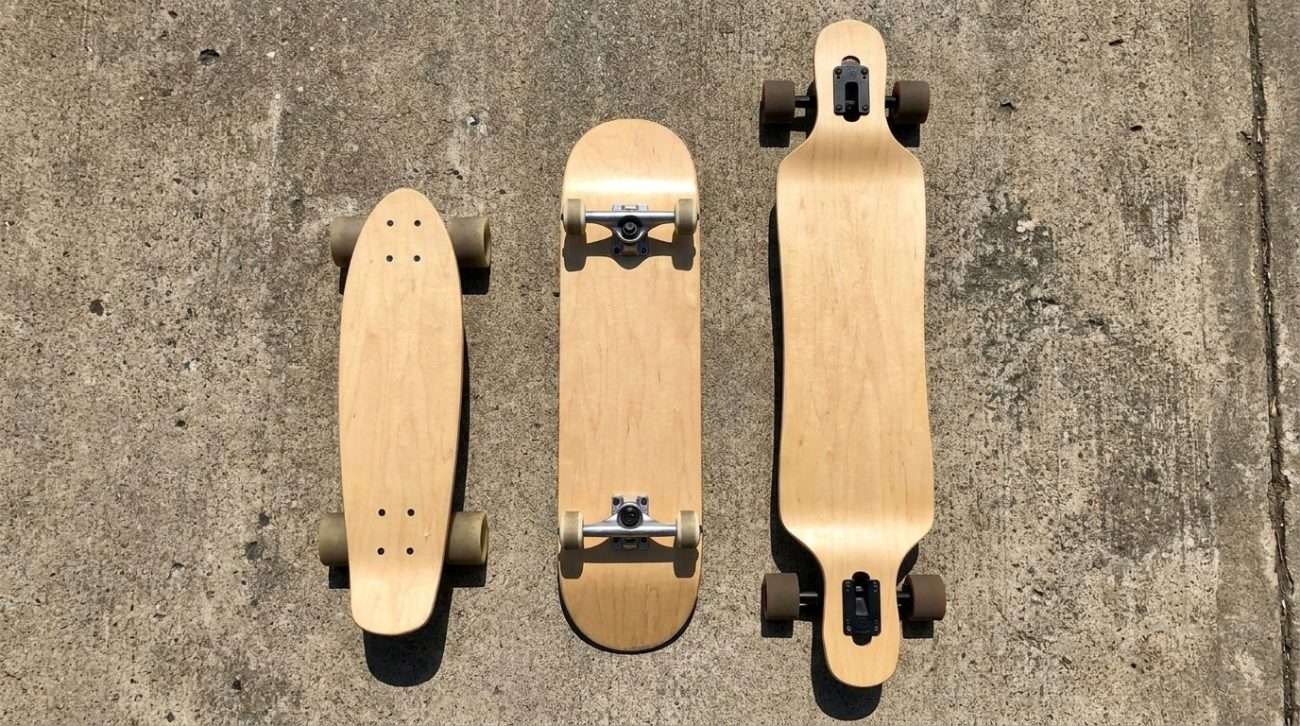
Longboards and skateboards differ in four ways that affect how they feel to ride. Everything else is mostly aesthetic.
| Longboard | Skateboard | |
| Length | 36–46″ | 28–33″ |
| Deck shape | Directional, flat or cambered | Symmetrical, with nose and tail kicks |
| Trucks | Reverse kingpin, wider stance | Traditional kingpin, narrower |
| Wheels | 65–80mm, soft (78A–85A) | 50–60mm, hard (99A–101A) |
What those differences produce in practice:
Longboards are stable at low to moderate speeds, forgiving of foot placement errors, and smooth over rough pavement — the soft, large wheels absorb road texture instead of transmitting it. They turn through body lean, not foot pressure on a kick tail. They don’t ollie. They aren’t designed to.
Skateboards are maneuverable, tail-heavy, and built around the kick tail — the upward curve at each end that makes tricks possible. Hard small wheels roll fast on smooth surfaces and slide predictably. On cracked pavement or brick paths, those same wheels transmit every bump directly to your feet. The board is harder to balance on at low speeds until you build the muscle memory for it.
Neither is better. They’re tools for different jobs.

7 Use Cases, 7 Answers
This is the section most people actually need. Match your situation to the answer.
01 · Campus commute — 0.5 to 2 miles each way
▹ Longboard. Stable enough to ride with a backpack, smooth enough for brick paths and pavement joints, and easy to carry into a lecture hall. A drop-through setup around 38–40″ is the standard starting point. See our beginner longboard guide for specific recommendations by campus riding style.
02 · Learning kickflips and street tricks
▹ Skateboard. Full stop. Tricks require a kick tail, a hard wheel that slides predictably, and a board short enough to flip. A longboard can’t do this by design — the geometry is wrong for it. Start with a standard 8″–8.5″ popsicle deck.
03 · Cruising at the beach or along a boardwalk
▹ Longboard. Long, smooth paths with gentle curves are exactly what longboards are built for. Any complete in the 38–42″ range with 78A wheels handles this well. A cruiser (see below) also works here if you want something smaller.
04 · First board for a 10–14 year old
▹ Longboard, with one caveat. Longboards are easier to learn balance on — the wider deck and stable trucks are forgiving while the rider builds foot confidence. The caveat: if the kid specifically wants to skate a skate park or learn tricks, get a skateboard. Don’t fight what they actually want to do.
05 · Replacing a car for under-2-mile errands
▹ Longboard. A 38–42″ drop-through at 70–75mm wheels covers flat urban terrain efficiently. You push, it rolls, you carry it inside. No lock, no storage problem, no parking. Our piece on longboard commuting and speed has realistic range and pace numbers if you want to map it to your specific route.
06 · Skating a skate park (bowls, ramps, transitions)
▹ Skateboard — mostly. Standard park skating is built around skateboard geometry. That said, some longboard riders skate mellow bowl transitions effectively, and there’s an overlap niche here. If the park is your primary goal, start with a skateboard. If you already ride a longboard and want to try park transitions, ask the park locals first.
07 · Just want something for occasional weekend rides, no specific plan
▹ Longboard or cruiser. A longboard in the 38–40″ range is the more versatile starting point — it’s stable enough to learn on and capable enough to grow with. A cruiser (28–32″) is a reasonable alternative if you want something that fits under a desk or in a locker.
What About Cruisers? The Third Option Most Guides Skip
A cruiser is a skateboard-sized board (28–34″) with longboard-style soft wheels and trucks. It carves and cruises but won’t do tricks — and it fits in a backpack.
Cruisers sit between longboards and skateboards in almost every dimension. They’re more portable than longboards and smoother than skateboards. The tradeoff is stability — at 28–32″, they’re noticeably less forgiving than a 40″ longboard, especially for new riders.
Who cruisers actually suit: city riders who need portability above all else, experienced riders who want a small second board for short trips, and people who’ve ridden before and want something nimble. For true beginners, a full-length longboard is still the easier starting point. Our full breakdown is in the longboard vs cruiser skateboard comparison if you want to go deeper on that decision.

Two Things This Comparison Gets Wrong (In Most Articles)
Misconception 1: Longboards are harder to learn than skateboards.
The opposite is true for most beginners. A longboard’s wider deck, lower center of gravity, and stable trucks make it significantly easier to stand on and push without falling. The challenge with skateboards isn’t the riding — it’s that the board is designed to be responsive to small movements, which makes it less forgiving while you’re learning basic balance. If someone tells you to “start on a skateboard because it’ll make you better,” that’s only true if tricks are your end goal.
Misconception 2: You can do tricks on a longboard if you practice enough.
You can do some things — manuals, carving lines, footbraking at speed. Ollies, kickflips, and most street tricks aren’t possible on a standard longboard because the geometry doesn’t allow it. The kick tail that makes tricks possible on a skateboard doesn’t exist on most longboards. Longboard freestyle and dancing are real disciplines with their own skill set — but they’re not skateboarding tricks.
Frequently Asked Questions
Which is easier to learn — longboard or skateboard?
Which is better for college students?
Can you use a longboard at a skate park?
Decided a longboard fits your situation better?
Our beginner guide matches boards to specific riding situations — campus commute, weekend cruising, first-time rider — with clear notes on what to look for at each budget. No brand fluff, no ranking lists.
Find the Right Longboard →About the Author

Jordan Ellis
Founder of Groveride · Former urban transportation analyst, Portland OR · Longboard rider since 2019 · Spent 5 years studying how people move through cities before building the board-buying guide that should have existed.
Read Jordan’s full story →