
Most people spend a lot of time choosing a deck and almost no time thinking about wheels. That’s backwards. The deck determines the shape of your ride. The wheels determine how that ride actually feels under your feet — on your specific roads, at your specific speed.
Here’s what to look at, and what to ignore.

Why Wheels Make More Difference Than Most People Expect
The board you buy comes with wheels. Those wheels were chosen to work reasonably well for most riders. They are not chosen for your commute, your road surface, or how hard you push.
Swapping wheels is the cheapest meaningful upgrade you can make to a longboard — usually $25–$55 — and the difference is immediate. You feel it on the first block.
In our experience testing boards across Portland city streets — brick crosswalks, expansion joints, patchy asphalt — the wheel swap consistently has more impact on day-to-day comfort than any other single change. A board that feels harsh and distracting on a rough commute often rides completely differently with a softer set of wheels underneath it. The deck hasn’t changed. The route hasn’t changed. The wheels did.
We’ve also seen this pattern in buyer feedback. One rider wrote in to say the board we recommended felt too rough on his city roads. He was right — the setup was solid for smooth paths, but his streets had real imperfections we hadn’t flagged clearly enough. That feedback changed how we describe wheel pairings across every product page. If you’re riding on broken pavement, the wheel spec matters more than almost anything else on the board.
The Two Numbers You Actually Need to Understand
Every wheel has two specs printed on it. Everything else is secondary.
Durometer (Hardness): What the A Scale Means for Your Ride
Durometer is measured on the A scale. The number tells you how hard the urethane is. For longboards, you’ll mostly see numbers between 74A and 85A.
| Durometer | Feel | Best for |
| 74A–78A | Soft, absorbs bumps | City streets, cracked pavement, brick paths |
| 79A–82A | Medium, balanced | Smooth bike paths, campus sidewalks |
| 83A–86A | Firm, faster roll | Skate parks, downhill, very smooth roads |
Soft wheels absorb road imperfections. Your knees notice the difference before your brain does — on a rough road with 83A wheels, you’ll start adjusting your weight and stance just to stay comfortable. That mental load adds up on a 20-minute commute.
Hard wheels roll faster on smooth surfaces and hold their shape better for technical riding. Put them on a brick path, and you’ll feel every joint in the pavement.
For most city and campus riders, 78A is the number to start with. It’s the point where you get meaningful vibration absorption without giving up too much roll speed.
We covered the full breakdown of A-scale ratings — including how body weight interacts with hardness — in our longboard wheel hardness and diameter guide.
Diameter: Why Bigger Isn’t Always Better
Wheel diameter is measured in millimeters. Most longboard wheels fall between 60mm and 75mm.
Bigger wheels roll faster and clear obstacles more easily — a pebble that stops a 60mm wheel barely registers on a 70mm one. But bigger wheels add weight and raise your center of gravity.
The practical range for most riders:
▹ 60–65mm — Lighter, quicker to accelerate, good for shorter commutes and smooth paths ▹ 65–70mm — The sweet spot for city commuting; enough clearance for cracks and debris, not too heavy ▹ 70mm+ — Better for longer rides and rougher terrain; noticeably heavier to push from a stop
One thing to check before sizing up: wheel bite. If your wheels are large and your board has low clearance, the wheel can contact the deck during a sharp turn. You stop. Fast. If you’re going bigger than your stock wheels, check whether you need riser pads — a 1/4″ riser solves the problem for most setups.
Matching Your Wheels to Where You Actually Ride
Specs only mean something in context. Here’s the translation.
Campus & City Streets (Cracked Pavement, Brick Paths)
Go with: 70mm / 78A
This is the setup that holds up on the kind of roads most American college campuses actually have — uneven sidewalks, brick crosswalks, expansion joints, and the occasional patch of gravel. Soft wheels on rough roads also reduce the micro-corrections your body makes without thinking, which means less fatigue on longer rides.
If you’re not sure what your roads are like, err toward softer. You can always go firmer later. Going too hard on a rough surface is immediately noticeable and unpleasant.
Smooth Paths & Bike Lanes
Go with: 65–68mm / 80A–82A
On clean asphalt or dedicated bike paths, you don’t need soft wheels to absorb imperfections. A slightly firmer wheel rolls faster and gives you more feedback from the road — useful if you’re working on carving technique.
Mixed Terrain or You’re Not Sure
Go with: 70mm / 78A
Honestly, this is the answer for most first-time wheel buyers. It’s the forgiving choice. You lose a little roll speed on perfect pavement and gain a lot of comfort everywhere else. For a commuter board, that trade is almost always worth it.
One Thing Most Guides Don’t Mention: Contact Patch
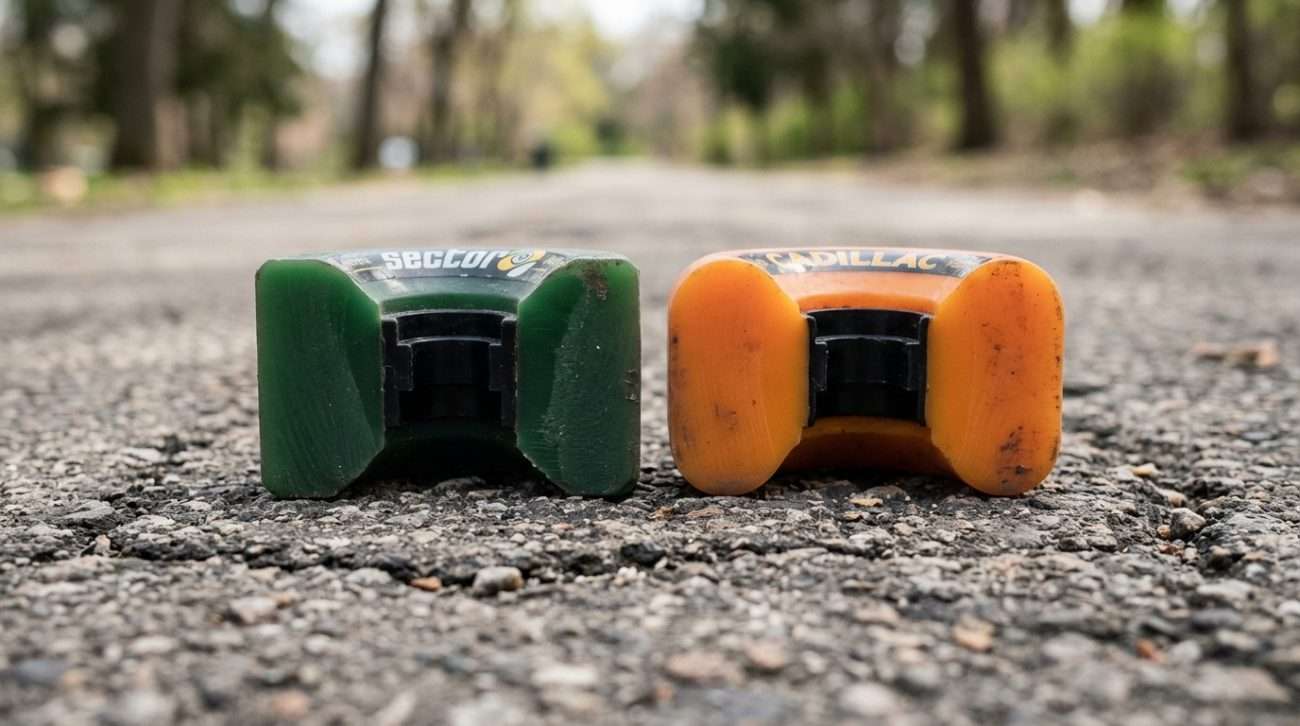
Contact patch is the width of the part of the wheel that actually touches the ground.
Wider contact patch → more grip → more stable, harder to slide intentionally. Narrower contact patch → less grip → easier to initiate slides, faster edge-to-edge in carving.
Most beginners want a wider contact patch. It’s more forgiving and harder to accidentally slide on a sharp turn. Freeride riders want narrower — it’s what makes controlled slides possible without fighting the wheel.
You’ll also see lip shape described as square or round. Square lips grip harder. Round lips release easier. For cruising and commuting, square lip is the default. If you’re interested in learning slides eventually, round lip gives you more control while learning the motion.
This is secondary information for most buyers. But if you’re choosing between two similar wheels and one has a wider contact patch, that one is the better everyday choice.
When to Upgrade Your Wheels (and When Not To)
Your stock wheels are worth replacing when:
▹ You notice vibration or buzzing on roads that used to feel fine — the urethane has likely hardened with age and temperature cycling. ▹ The wheels have visible flat spots from emergency stops or accidental slides. ▹ You’ve changed how you ride — you started on smooth paths and now commute on city streets, or vice versa.
It’s probably not worth replacing your wheels when:
▹ You’ve had the board for less than three months and haven’t ridden it on varied surfaces yet. Give the wheels — and your feet — time to settle. ▹ You’re riding on consistently clean surfaces and the board feels fine. “Better wheels exist” is not a reason to spend money.
Wheels on a well-maintained board typically last 1–3 years of regular riding before performance drops noticeably. Bearings usually go first — if your roll sounds rough or gritty, check the bushing and bearing setup before assuming the wheels are the problem.
For the full picture on how wheels, trucks, and bearings work together, our longboard parts guide covers the complete component picture.
Frequently Asked Questions
Can I put longboard wheels on a regular skateboard?
How long do longboard wheels last?
Do softer wheels always mean a smoother ride?
About the Author

Jordan Ellis
Founder of Groveride · Former urban transportation analyst, Portland OR · Longboard rider since 2019 · Spent 5 years studying how people move through cities before building the board-buying guide that should have existed.
Read Jordan’s full story →